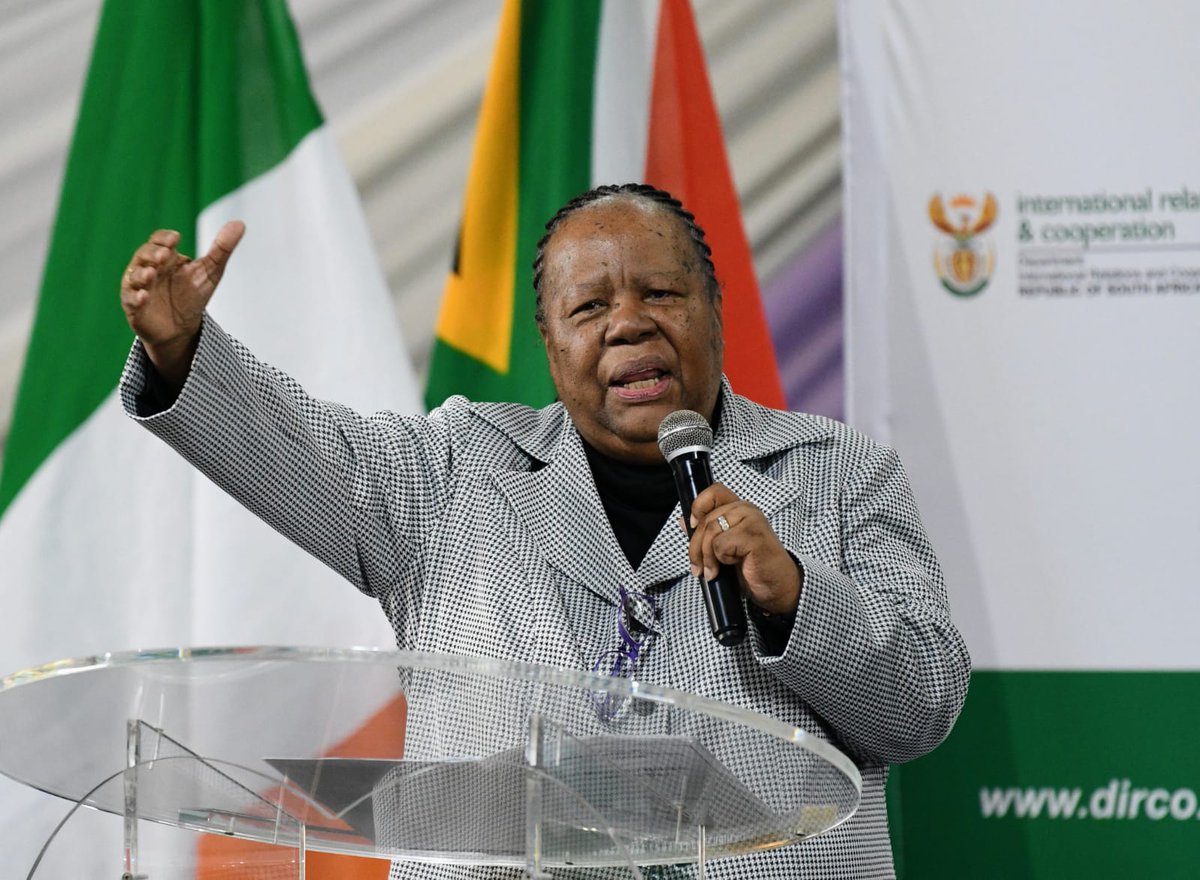
South Africa must brace for a more volatile global order in 2026, former international relations minister Naledi Pandor warned this week, cautioning that rising geopolitical fractures, shifting trade alliances, and economic nationalism could test both government and corporate strategy in unprecedented ways.
Addressing an audience at the Nelson Mandela Foundation, Naledi Pandor delivered a stark assessment of the global landscape, arguing that the turbulence of recent years may only be a precursor to deeper instability. Trade wars, regional conflicts, shifting alliances and intensifying competition between major powers, she said, are reshaping the rules of engagement.
“If you think the global environment feels uncertain today, 2026 may be even scarier,” Pandor told attendees, urging leaders not to underestimate the speed at which geopolitical risk can escalate.
A World Reordering Itself
Pandor’s remarks come at a time when established trade corridors are being reconfigured. Economic blocs are consolidating, supply chains are being regionalised, and sanctions regimes are increasingly weaponised as tools of diplomacy. For South Africa, whose economy depends heavily on exports and global integration, these shifts carry significant implications.
She argued that Africa cannot afford to remain reactive. Instead, governments and corporations alike must anticipate how realignments among the United States, China, the European Union and emerging powers will alter investment flows, market access and technological cooperation.
Corporate SA’s Strategic Moment
Pandor placed particular emphasis on the private sector, calling on Corporate South Africa to move beyond short-term profit calculations and embed geopolitical literacy into boardroom decision-making. Risk assessments, she suggested, must now include political volatility, energy security, climate disruptions and digital sovereignty.
“Business cannot assume stability as a default setting,” she said. “Strategic foresight is no longer optional — it is a survival tool.”
Her comments reflect growing concern that global fragmentation could disrupt supply chains, raise borrowing costs and complicate cross-border investments. Companies reliant on single-market exports or concentrated sourcing models may find themselves exposed if diplomatic tensions spill into economic restrictions.
Africa’s Leverage in a Fractured Era
Despite the warning, Pandor did not frame the future solely in pessimistic terms. She argued that Africa’s expanding consumer base, mineral wealth and strategic geographic positioning offer leverage in a world hungry for new partnerships. The African Continental Free Trade Area, she noted, remains a critical instrument for strengthening regional resilience.
However, she cautioned that opportunity will favour countries and companies that prepare early. Diplomatic agility, diversified trade routes and investment in innovation could determine which economies weather the next phase of global disruption.
- Diversifying export markets beyond traditional partners.
- Strengthening regional supply chains within Africa.
- Investing in scenario planning and geopolitical risk analysis.
- Aligning corporate strategy with long-term national development goals.
Analysts present at the event said the message signals a broader shift in how foreign policy and economic strategy intersect. South Africa’s positioning within BRICS and its historical ties to Western markets require careful balancing in an era where neutrality is increasingly scrutinised.
Whether 2026 proves to be as destabilising as Pandor anticipates remains uncertain. Yet her warning underscores a central reality: in a rapidly changing global order, complacency may carry the greatest risk. For policymakers and boardrooms alike, the time for passive observation appears to be over.