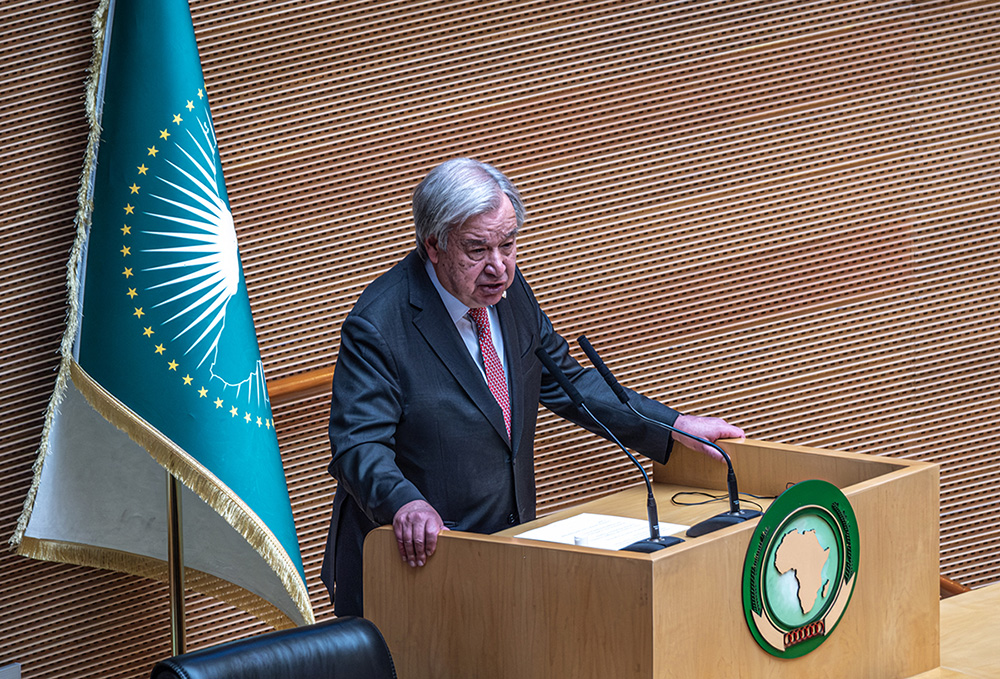
United Nations Secretary-General António Guterres has renewed his push for reform of the UN Security Council, arguing that the body’s structure reflects a post-World War II order that no longer matches global political and economic realities.
Speaking before member states at UN headquarters in New York, Secretary-General António Guterres argued that the Security Council’s composition and decision-making powers are rooted in 1946 — a vastly different political era shaped by the aftermath of World War II.
"This is 2026 – not 1946," Guterres told delegates, stressing that legitimacy in global governance depends on institutions reflecting current geopolitical and economic realities.
The Security Council currently consists of 15 members, including five permanent powers — the United States, the United Kingdom, France, Russia, and China — each wielding veto authority. While that structure was designed to prevent another global conflict among major powers, critics argue it now hampers effective action on modern crises.
A Question of Representation
Calls for reform have intensified in recent years, particularly from African, Latin American, and Asian nations that say the council fails to represent the demographic and economic weight of the Global South. Africa, for instance, has no permanent seat despite comprising 54 member states.
Several reform proposals include expanding both permanent and non-permanent membership, limiting or suspending veto use in cases involving mass atrocities, and introducing longer-term elected seats for emerging powers.
Veto Power: The Central Obstacle
At the heart of the debate lies the veto. Any meaningful amendment to the UN Charter would require approval from two-thirds of the General Assembly and ratification by all five permanent members — including those whose influence could be diluted by reform.
The veto has repeatedly stalled resolutions on conflicts in Ukraine, Gaza, and Syria, exposing deep divisions among major powers and raising questions about the council’s ability to act decisively during humanitarian emergencies.
Credibility and the Future of Multilateralism
Guterres framed reform not simply as a procedural adjustment but as a test of the UN’s relevance. He warned that public trust in multilateral institutions erodes when decision-making appears disconnected from contemporary realities.
Analysts note that without structural change, parallel alliances and regional blocs may increasingly bypass the Security Council, further fragmenting global governance.
For now, reform discussions remain incremental and politically sensitive. Yet Guterres’ message was clear: a system designed for the mid-20th century cannot effectively manage the complexities of the 21st.
Whether member states can bridge strategic rivalries and agree on structural change will determine not only the future of the Security Council but also the credibility of the United Nations itself.