News Afrika
News Afrika
HomePoliticsEconomyMediaBusinessTechnologyHealth

Privacy PolicyTerms of ServiceAbout UsContact UsEditorial PolicyCorrections PolicyOwnership & FundingOur TeamCookie PolicySitemap

© 2026 News Afrika • Independent African Journalism • All Rights Reserved

    HomeWorldTinubu Declares Food Emergency as Nigeria Inflation Hits 35%
    World

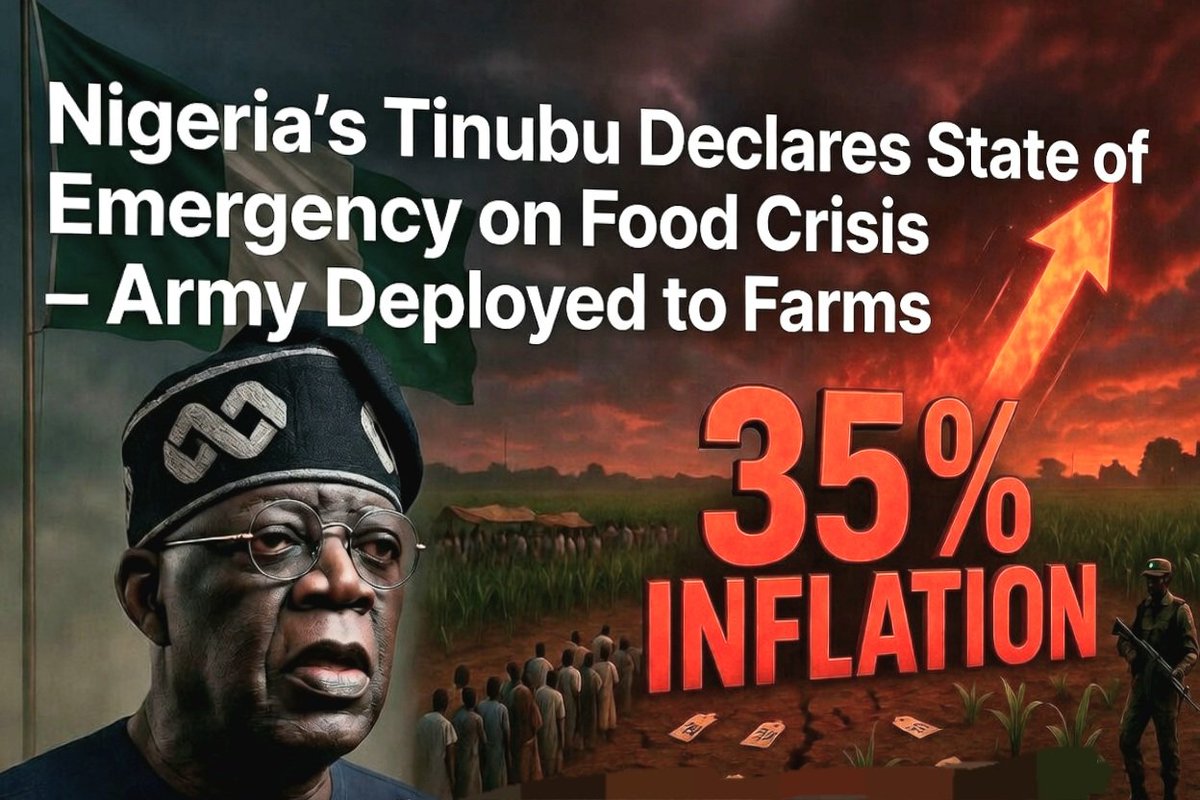
    Tinubu Declares Food Emergency as Nigeria Inflation Hits 35%

    Army deployed to protect farms as Africa’s largest economy faces deepening food insecurity and regional spillover risks.

    By:Maria Masuluke
    February 24, 2026
    2 min read
    President Bola Tinubu addressing officials during national economic briefing
    President Bola Tinubu announces emergency measures to tackle Nigeria’s worsening food crisis. | Photo: Official Presidency Photo
    • •Inflation climbs to 35%, worsening food affordability crisis
    • •Army deployed to secure farming communities
    • •Naira volatility deepens import costs
    • •Regional food supply chains at risk

    Nigeria’s President Bola Tinubu has declared a state of emergency on food security after inflation surged to 35%, triggering widespread hardship across Africa’s biggest economy. In an unprecedented move, security forces have been deployed to farming zones to stabilise production and curb supply disruptions.

    Nigeria has entered one of the most economically fragile periods in its modern history. With inflation surging to 35%, food prices have become the epicentre of public anger, squeezing households already battling unemployment and currency volatility. The declaration of a food emergency marks a dramatic escalation by President Bola Tinubu’s administration as pressure mounts from markets and citizens alike.

    Why Food Became the Breaking Point

    Food accounts for a dominant share of household spending in Nigeria, meaning inflation hits hardest at the kitchen table. Staple crops such as rice, maize and cassava have seen steep price increases driven by insecurity in farming regions, high fuel costs, and supply chain disruptions. The weakening naira has compounded the crisis, making imports significantly more expensive and deepening dependence on unstable domestic production.

    By deploying the army to protect farms and agricultural corridors, the government is signalling that food security is now a national security issue. Armed banditry and farmer–herder conflicts have reduced cultivated land in key northern states. Securing these zones is intended to restore confidence among farmers and prevent further production decline ahead of critical planting seasons.

    Economic Shockwaves Beyond Nigeria

    As Africa’s largest economy, Nigeria’s instability rarely remains contained. Cross-border trade flows into neighbouring West African countries could tighten if domestic shortages intensify. Investors are already reassessing exposure, concerned that prolonged inflation may trigger capital flight, currency pressure and social unrest.

    The crisis also exposes structural weaknesses: heavy import dependence, limited storage infrastructure, and underinvestment in mechanised agriculture. Emergency deployment may stabilise immediate threats, but sustainable recovery requires policy coherence — from exchange rate management to rural security reform and logistics modernisation.

    What Happens Next?

    The coming months will test whether emergency measures translate into measurable food supply gains. If harvest volumes improve and inflation moderates, confidence could slowly return. However, if security deployments fail to restore production or if currency pressures intensify, Nigeria risks entering a prolonged stagflation cycle — slow growth paired with persistent price shocks.

    For millions of Nigerians, this is no longer a macroeconomic debate but a daily survival calculation. The state of emergency signals urgency. Whether it becomes a turning point or a temporary pause in decline will depend on execution, transparency, and the government’s ability to convert military presence into lasting agricultural reform.

    Sources

    • National Bureau of Statistics Nigeria – Inflation Data
    • Presidency of Nigeria – Official Statements

    Tags

    Nigeria inflation
    Food crisis
    Bola Tinubu
    African economy
    Military deployment
    Cost of living

    Related Stories

    President Donald J. Trump Departs the South Lawn | by whitehouse45
    INTERNATIONAL RELATIONS
    •5 MIN READ

    How Donald Trump’s Foreign Policy Could Reshape US–Africa Relations in 2026

    The direction of United States foreign policy has long carried major implications for Africa’s economic partnerships, security cooperation, and diplomatic alignment. In 2026, renewed attention on Washington’s international priorities has sparked debate among analysts about how the foreign policy approach associated with Donald Trump could influence relations between the United States and African nations.

    March 9, 2026
    Bulk carrier vessels navigating open waters, symbolizing global maritime trade routes under pressure.
    GLOBAL ECONOMY
    •3 MIN READ

    Global Shipping Disruptions Return: Why 2026 Could Test Supply Chains More Severely Than 2022

    Early indicators suggest that global supply chains are once again entering a stress phase. Freight benchmarks are edging upward, insurers are repricing maritime risk, and vessels are rerouting around sensitive corridors. While the system is not yet in crisis, the structural buffers built after 2022 are now being tested under a new combination of geopolitical and climate pressures.

    March 3, 2026
    Several South African Airways aircraft parked on the sunny airport tarmac with clear blue skies and a terminal building visible.
    AVIATION
    •2 MIN READ

    Johannesburg to Dubai: Travel Uncertainty Grows Amid Escalation

    Flights between Johannesburg and Dubai have long symbolised opportunity — linking Southern Africa to global markets, tourism hubs and investment corridors. But as regional tensions intensify, uncertainty is beginning to ripple through air travel, raising fresh questions about route stability, insurance costs and passenger confidence.

    March 2, 2026
    Silhouette of oil pumpjack and wind turbines against orange sunset sky with sun visible.
    ENERGY
    •2 MIN READ

    Oil at the Brink: How Middle East Tensions Threaten to Trigger a Worldwide Energy Shock

    Oil markets are once again on edge as rising Middle East tensions threaten key production hubs and shipping corridors. With traders pricing in supply disruption risks, even limited attacks could trigger a global energy shock that reverberates from fuel pumps to food prices.

    March 2, 2026